Morning Panic Before Exams: 5 Evidence-Based Techniques That Work in 10 Minutes
28th February, 2026 | By: Sagarika UK
You wake up before an exam, and your body is already ahead of you.
Your heart is racing before you’ve even checked the time. Your chest feels tight. Your stomach is unsettled. Thoughts begin forming almost instantly: What if I blank out? What if I studied the wrong things? What if I fail?
You haven’t even left your bed, but your nervous system is fully activated. Most people call this “exam stress.” But what you are experiencing in that moment is not simply stress. It is a coordinated biological response designed to prepare you for threat. And while an exam is not physically dangerous, your brain sometimes treats it like one.
The good news? Biological responses can be interrupted. And often, they can be shifted in minutes.
What Happens in the Brain on Exam Morning
To understand why panic feels so intense in the morning, we have to understand what the brain is doing.
At the centre of the fear response is the amygdala -the brain’s threat detection system. When it perceives something as high-stakes or uncertain, it activates the hypothalamic–pituitary–adrenal (HPA) axis, triggering the release of stress hormones like adrenaline and cortisol. Cortisol is not a “bad” hormone. In fact, it is essential. It increases alertness, sharpens attention, and mobilises energy.
However, there is an important biological detail: cortisol is naturally highest in the morning. This is known as the Cortisol Awakening Response (CAR). Within 30–45 minutes of waking, cortisol levels rise significantly to help us transition into wakefulness. If you add exam anticipation to this already elevated hormonal state, your system can become overloaded. This is why morning panic feels sharper than anxiety the night before.
When cortisol and adrenaline surge:
- Heart rate increases
- Breathing becomes rapid and shallow
- Muscles tense
- Hands may feel cold or sweaty
- Digestion slows (leading to nausea or loss of appetite)
- The prefrontal cortex which is responsible for working memory and reasoning becomes less efficient
In other words, the more panicked you feel, the harder it becomes to think clearly. However, it is imperative to remember that this is not weakness and is only an exaggerated neurobiological response at play. And neurobiology can be regulated.
Why “Just Calm Down” Doesn’t Work
When someone says, “just relax,” they are speaking to your thinking brain or your pre-frontal cortex. But panic originates in subcortical survival circuits including the amygdala(lesser evolved brain areas that are responsible for keeping you alive). The amygdala activates faster than conscious reasoning. By the time you are aware of anxiety, your body has already shifted into sympathetic activation.
You cannot argue with adrenaline. You must regulate the body first and only then cognition follows.
Below are five evidence-based techniques that target the nervous system directly. Together, they can interrupt the panic cycle in under 10 minutes.
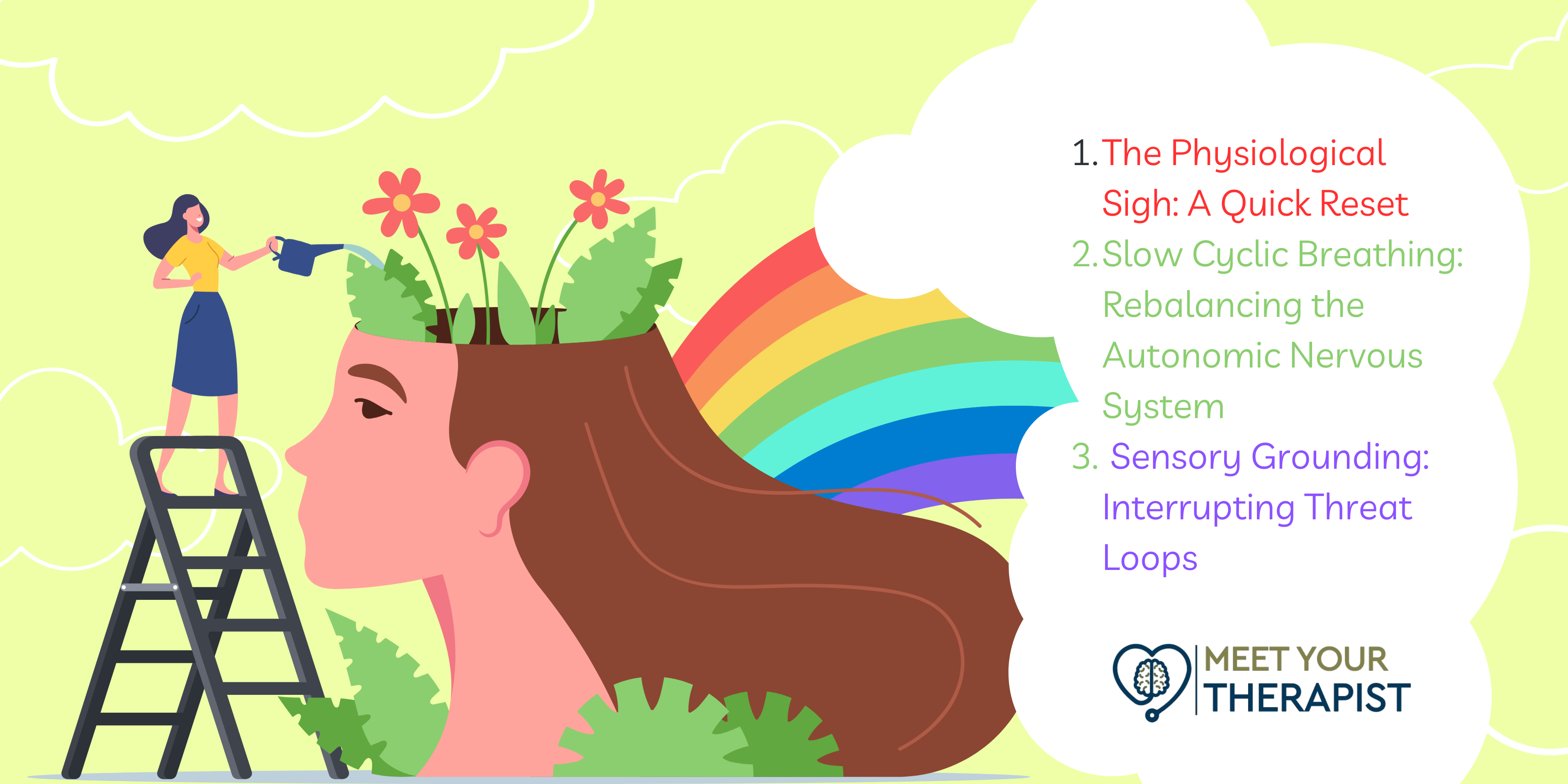
- The Physiological Sigh: A Quick Reset
- Inhale through your nose
- Take a second short inhale to fully expand the lungs.
- Slowly exhale through your mouth.
- Repeat 3–5 times.
- Slow Cyclic Breathing: Rebalancing the Autonomic Nervous System
- Inhale for 4 seconds
- Exhale for 6 seconds
- Continue for 2–4 minutes
- Heart rate begins to stabilise
- Muscle tension reduces
- Blood flow to the prefrontal cortex improves
- Sensory Grounding: Interrupting Threat Loops
- 5 things you can see
- 4 things you can feel
- 3 things you can hear
- 2 things you can smell
- 1 thing you can taste
- Hold something cold.
- Press your feet firmly into the floor.
- Name the colours you see around you.
- Cognitive Defusion: Reducing the Grip of Thoughts
- Social Regulation: The Power of Co-Regulation
- Calling a trusted person
- Sending a short message
- Reading an encouraging note saved on your phone
The physiological sigh is one of the fastest scientifically studied breathing interventions for stress reduction. How to do it:
Research in respiratory physiology shows that this breathing pattern helps rebalance oxygen and carbon dioxide levels, which often become dysregulated during anxiety. The long exhale activates the vagus nerve, increasing parasympathetic activity and lowering heart rate. Many people report a noticeable drop in physiological intensity within minutes
Once the immediate spike softens, continue with slow breathing:
The extended exhale is critical. Research on heart rate variability (HRV) demonstrates that slow breathing increases vagal tone which is the nervous system’s capacity to return to baseline after stress. Higher vagal tone is associated with improved emotional regulation and cognitive clarity. You are not suppressing anxiety but are rebalancing sympathetic and parasympathetic systems. Within a few minutes:
Panic narrows attention. The brain becomes fixated on catastrophic predictions. Grounding widens attention again.Try the 5-4-3-2-1 technique:
This shifts activity toward the somatosensory cortex and away from repetitive threat-based rumination networks. Other quick grounding options:
These simple acts signal to the brain: I am here. I am safe. The environment is stable. That message reduces amygdala intensity.
Anxiety before exams often produces rigid, absolute statements:
“If I fail this, everything is over.”
“I’m not prepared enough.”
“Everyone else knows more than me.”
In Acceptance and Commitment Therapy (ACT), a process called cognitive defusion helps create space between you and your thoughts.Instead of:
“I’m going to fail.”
Try:
“I’m noticing that I’m having the thought that I’m going to fail.”
This subtle shift engages the prefrontal cortex and reduces emotional intensity. Research in ACT interventions shows that defusion techniques decrease the believability and distress linked to anxious cognitions. You do not need to replace the thought with a positive one. You only need to loosen its hold. Thoughts are mental events and not predictions of a future that has not yet happened.
Humans are biologically wired for connection. Attachment and social neuroscience research consistently shows that supportive contact reduces stress responses. Hearing a calm, familiar voice can lower cortisol and increase oxytocin -a hormone associated with bonding and safety. Before leaving for your exam, consider:
Even brief connection can anchor your nervous system. This is not dependency. It is co-regulation ; a built-in human mechanism for emotional balance.
A Balanced Perspective on Anxiety
Not all anxiety is harmful. In fact, moderate levels of arousal can improve performance by enhancing focus and alertness. The goal is not to eliminate anxiety completely. The goal is to prevent it from escalating into panic that interferes with memory and reasoning. Anxiety signals that something matters to you. What it does not signal is incompetence.
If exam anxiety becomes persistent, overwhelming, or begins affecting sleep, appetite, or daily functioning beyond exam days, professional support can be helpful. Evidence-based therapies such as Cognitive Behavioural Therapy (CBT) and ACT are highly effective for anxiety regulation.
At Meet Your Therapist, trained psychologists work with students and adults to understand the roots of anxiety and develop structured regulation strategies that go beyond quick fixes. You do not have to manage chronic anxiety alone.
Final Thoughts
Morning panic before an exam can feel urgent and consuming. But it is a temporary physiological state not a reflection of your intelligence or your future. You may still feel some nerves and that’s okay. Regulation is not about becoming completely calm. It is about becoming steady enough to show up. And sometimes, that is more than enough.