The Silent Mental Load: Why Women Are Always Tired (Even When They “Did Nothing”)
07th March, 2026 | By: Sagarika UK
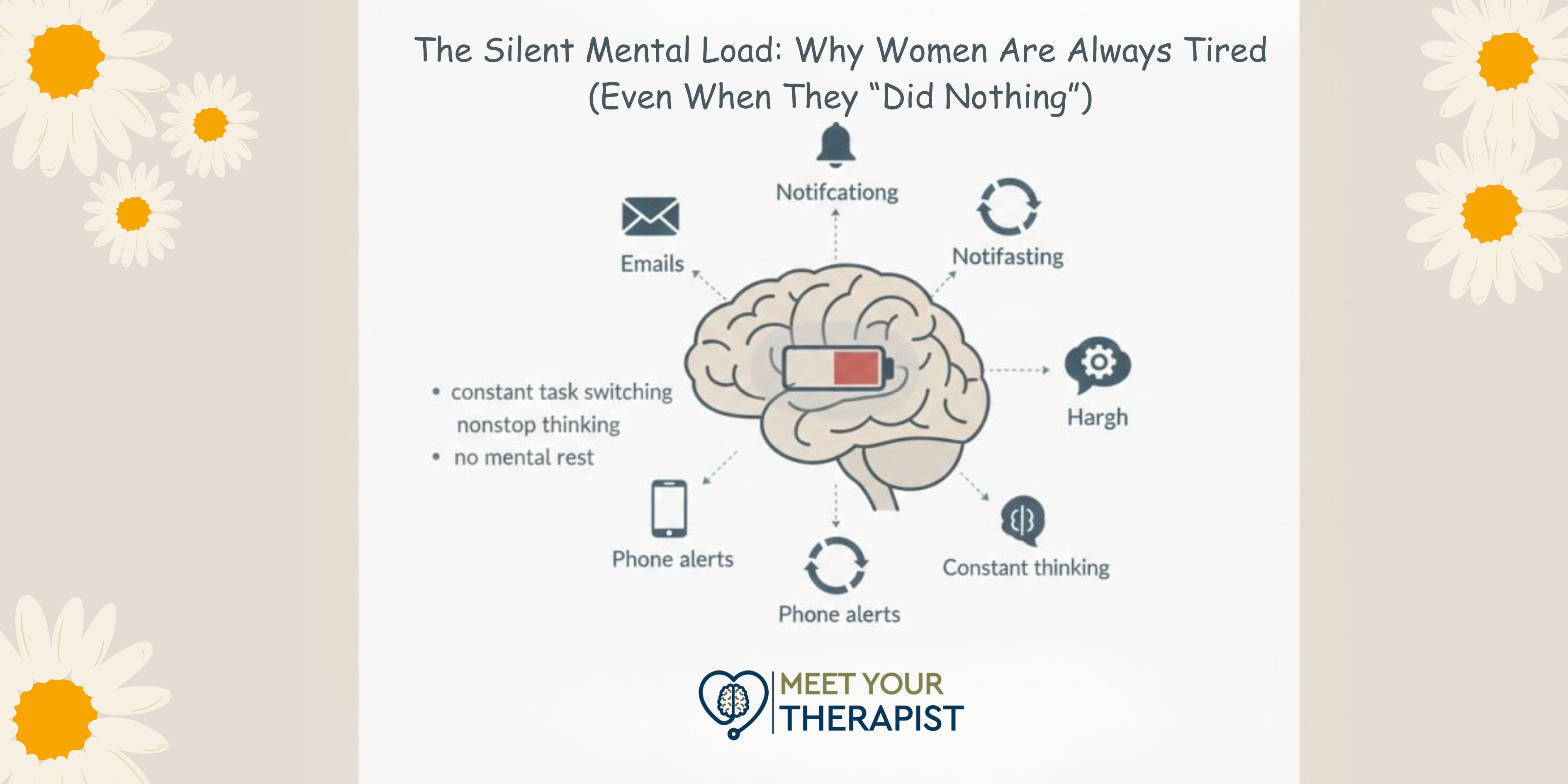
There is a particular kind of exhaustion that is difficult to explain. It’s the kind that appears at the end of a seemingly ordinary day. Nothing dramatic happened. There was no physical labour, no marathon meeting schedule, no visible crisis. And yet, by evening, your body feels heavy, your mind feels cluttered, and rest doesn’t quite restore you.
When someone casually asks, “What did you do today?” the answer feels strangely inadequate. Because much of what you did cannot be easily listed. You remembered things; you anticipated things; you managed emotions and you kept track of invisible responsibilities.
For many women , particularly urban Indian women balancing work, relationships, and family ,this constant mental management creates what psychologists increasingly recognise as the mental load.
And it is exhausting.
The Work That No One Sees
Emotional Labour
The term emotional labour was first introduced by sociologist Arlie Hochschild to describe the effort involved in managing emotions both your own and other people’s as part of daily life. While Hochschild originally applied it to service professions, the concept has since become central to understanding gender dynamics within households.
Emotional labour includes things like:
- Calming a partner who had a stressful day
- Remembering a relative’s birthday
- Mediating conflicts between family members
- Maintaining social harmony in gatherings
- Being the one who notices when someone else is upset
It is work but it rarely gets recognised as work.
Invisible labour
Alongside emotional labour is invisible labour: tasks that are necessary for life to run smoothly but are often unnoticed because they happen in the background.These responsibilities rarely appear on official to-do lists, yet they require constant attention.
Who keeps track of groceries running low?
Who remembers when the gas cylinder needs replacing?
Who notices when the household help is on leave and adjusts the day accordingly?
Cognitive labour
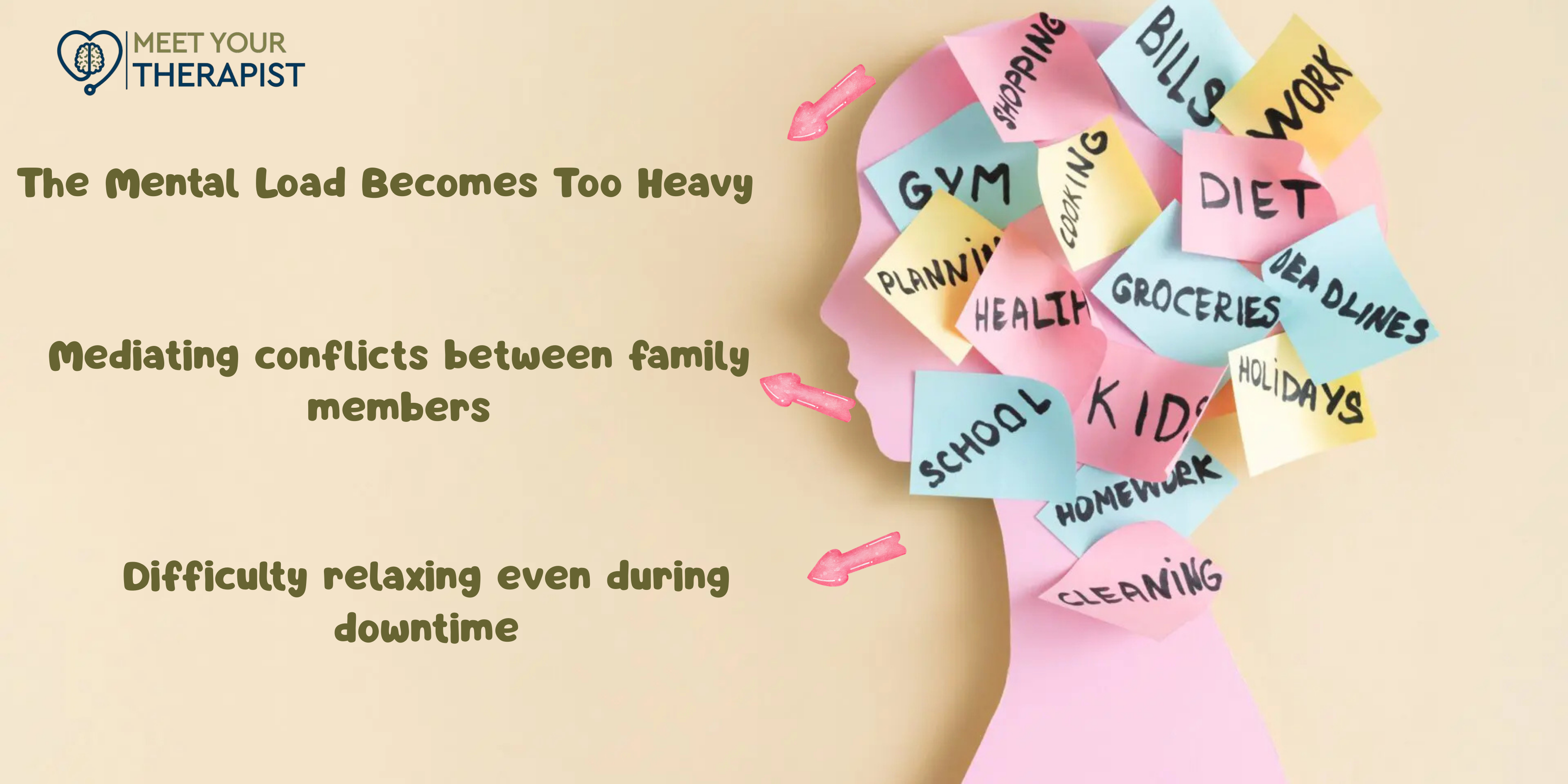
Then there is cognitive labour, also what is often referred to as the mental load. This involves the ongoing process of planning, organising, anticipating, and remembering everything that keeps a household functioning.
Cognitive labour includes:
- Scheduling appointments
- Planning meals
- Keeping track of children’s school activities
- Monitoring finances
- Remembering social obligations
- Anticipating problems before they occur
This is not just about doing tasks but rather about carrying the responsibility for thinking about the tasks in the first place. And for many women, that responsibility rarely switches off.
A culture coloured lens
In India, the mental load is not simply a personal issue. It is deeply tied to social expectations and cultural conditioning. Data from India’s Time Use Survey highlights a stark imbalance. On average, Indian women spend over five times more hours on unpaid domestic and caregiving work than men. Even among urban, educated households with dual incomes, women tend to shoulder the majority of household planning and emotional management.
This imbalance creates what sociologists call the “second shift.” After completing a full day of paid work, many women return home to begin another shift of unpaid labour cooking, coordinating, caregiving, organising. But beyond these visible tasks lies the less visible mental responsibility of ensuring that everything continues to function smoothly.
Cultural narratives often reinforce this pattern. From a young age, girls are socialised to be attentive, nurturing, and responsible for maintaining relationships. Competence in managing domestic and emotional responsibilities becomes part of what it means to be seen as a “good” daughter, partner, or mother.
Over time, this conditioning creates an internalised expectation: If something goes wrong, I should have anticipated it. The result is a constant background process of monitoring and planning. And it rarely receives recognition.
Why Mental Load Is So Draining
The exhaustion many women describe is not simply physical fatigue. It is cognitive overload. The brain has a limited capacity for attention and decision-making. When a large portion of that capacity is continuously occupied with remembering, anticipating, and coordinating tasks, mental resources become depleted.
Psychologists refer to this as decision fatigue -the gradual deterioration in the quality of decisions after a long period of cognitive effort. Additionally, chronic mental load can activate prolonged stress responses. When the brain constantly scans for potential problems or responsibilities, the body may remain in a low-grade state of alertness. Over time, this can lead to:
- Difficulty relaxing even during downtime
- Irritability and reduced concentration
- Persistent tiredness despite rest
- A sense of always being “on”
What makes this particularly frustrating is that the work causing the exhaustion often goes unnoticed both by others and sometimes by the women themselves. If no one sees the work, it can begin to feel as though the exhaustion must be personal failure. But it is not. It is the natural consequence of carrying a disproportionate share of cognitive and emotional responsibility.
When Competence Becomes a Trap
Ironically, the more capable someone is at managing the mental load, the more likely it is that the responsibility will continue to fall on them.Many women become exceptionally skilled at anticipating needs and preventing problems before they arise. Over time, this competence can lead to a subtle but powerful assumption within families: she will take care of it.
This is how unequal systems often sustain themselves -not through explicit rules, but through habits that quietly redistribute labour in predictable directions. Comments like “You’re just better at organising things” or “You remember these things more easily” may sound like compliments. But they can also function as a way of maintaining unequal responsibilities. And because much of the labour happens internally i.e. planning, remembering, worrying , it rarely becomes visible enough to challenge.
Beginning to Lighten the Load
Addressing the mental load is not simply about better time management. It often requires making invisible work visible. One starting point can be naming the responsibilities that are currently being carried silently. Many women find it useful to mentally audit the tasks they track each day ; not just what they do, but what they remember, anticipate, and manage.
Sometimes, sharing this mental inventory with partners or family members can open conversations about redistributing responsibilities more consciously. Small changes can also help: allowing others to take ownership of tasks without supervision, resisting the urge to pre-empt every potential problem, and creating boundaries around emotional availability. However, when exhaustion has built up over years, these shifts can feel difficult to implement alone.
When the Mental Load Becomes Too Heavy
If the constant sense of tiredness, overwhelm, or responsibility begins to affect mood, relationships, or overall wellbeing, it may be helpful to speak with a mental health professional. Sometimes the most important step is having a space where this invisible labour can finally be recognised and unpacked.
At Meet Your Therapist, trained psychologists work with individuals and couples to explore patterns of emotional labour, burnout, and mental load within relationships and family systems. Therapy can help people identify where responsibilities have become imbalanced and develop healthier ways of sharing them.
Because exhaustion should not be the default state of living. And the work you carry even when it is invisible is real.